
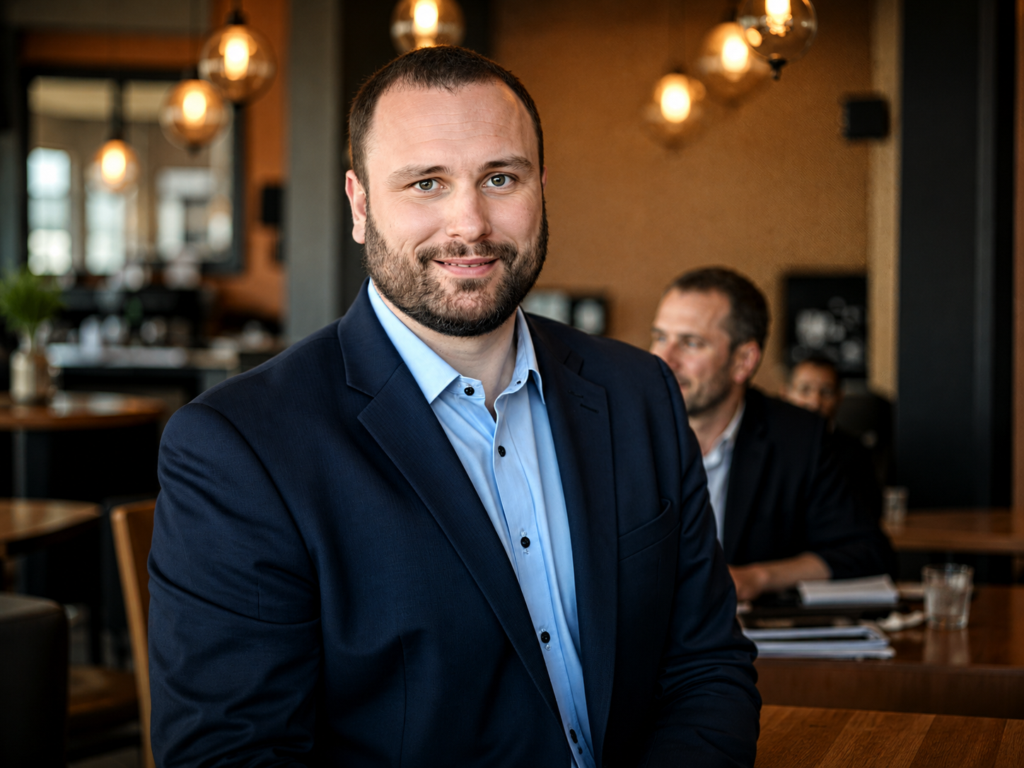

Before Jason Russell was keeping small businesses safe, he spent a decade protecting information where getting it wrong had real consequences — Navy cryptologic work, contracting at the NSA, then leading a tactical biometrics cell in Iraq. That instinct didn’t switch off when he came home. It’s the spine under everything HarmonyMSP does. We sat down with our founder for an honest conversation about where the company came from, what that background taught him about real security versus the kind that’s just sold to scare you, and the kind of business owner he’s actually built to serve. Jason’s not a slick-pitch guy, and this isn’t a slick-pitch interview — it’s a straight look at why we do things the way we do, and what we’re trying to build for the people who trust us with the stuff they’d rather not think about. Here’s the conversation.
In your own words, how do you describe what you do and who you do it for?
I run HarmonyMSP. We’re a managed IT and cybersecurity company originally founded as Harmony Tech in 2011 and based in Lake Mary, just north of Orlando. The plain-English version: I’m the person small businesses call so they don’t have to think about their technology. We run the whole thing for them — the everyday support, the security, keeping systems up and protected, the compliance piece — so the owner can get back to actually running their business instead of fighting with their computers.
Who I do it for is small businesses across Central Florida, usually somewhere between 5 and 50 employees, within about an hour of Lake Mary. My sweet spot is medical, dental, and legal practices, because those folks are on the hook for HIPAA and patient or client data, and they need a partner who actually understands compliance and security — not just someone who shows up to reset a password. I work with plenty of regular small businesses too. At the end of the day, it’s for any owner who’s tired of technology being a constant headache and just wants one dependable team to own it for them.
What does that actually look like day to day for your clients? What are you typically taking off their plate?
Honestly, most of it is stuff they never want to think about — and that’s the point. Day to day, we’re the ones watching their systems in the background, installing the updates, catching the problem before they even notice something’s wrong. When someone on their team can’t print, or their email’s acting up, or they’re locked out of a file they need for a 9 a.m. appointment — they call us, and we fix it. They get one number and a team that actually knows their setup, instead of googling it or asking the one person in the office who’s “good with computers.”
Under the hood, we’re handling the things that quietly keep them safe and running. Backing up their data so a crashed laptop or a ransomware scare doesn’t wipe them out. Running the security — antivirus, monitoring, locking down logins, training their staff so nobody clicks the wrong email. Managing all the technology vendors so they’re not stuck on hold with the internet company. And for my medical, dental, and legal clients, keeping them squared away on the compliance side so they’re not sweating a HIPAA audit.
The simplest way I put it: I take the entire “technology” headache off the owner’s plate. They stop being the IT department by accident, and they stop worrying about whether they’re protected — because that’s my job now, not theirs.
What kind of person is that owner, typically? Paint me a picture of who you’re really built for.
Honestly? It’s the owner who’s good at their actual job — the dentist, the attorney, the practice manager — and has just quietly become the IT department by accident. Nobody hired them to do it. It happened over the years because someone had to, and they were the one who could halfway figure it out. So now they’re the person resetting the Wi-Fi before the first patient, fielding the “I can’t log in” texts, and lying awake wondering if their backups actually work.
They’re usually running somewhere between 5 and 50 people, and they’ve hit the point where the business has outgrown the duct-tape setup that got them here. Maybe they had a “computer guy” who’s gone dark, or a nephew who set things up three years ago and never came back. Maybe they’ve had a scare — a phishing email that almost worked, a system down for a full day, a HIPAA letter that made their stomach drop — and they realized they’re one bad morning away from a real problem. They’re not careless. They just never had time to take it seriously, and now it’s keeping them up.
The thing they all share is they’re done. Done being the bottleneck, done worrying whether they’re protected, done piecing it together themselves. They don’t want to learn IT — they want to hand it to someone who’s genuinely got it, and then stop thinking about it. That’s who I’m built for: the owner who’s ready to trust one dependable partner with the whole thing so they can get back to the work they actually care about.
And the verticals where this hits hardest are the ones with real stakes attached — medical, dental, and legal. When patient records or client files are on the line, “good enough” technology isn’t good enough, and they know it. That’s exactly where I do my best work.
So flip that around — who are you absolutely not for? Who should walk right past HarmonyMSP?
Honestly, this matters as much as who I am for. I’m not for the business that sees IT as a cost to squeeze to zero. If you’re shopping purely on price and you want the cheapest guy who’ll keep the lights on — I’m not him, and we’ll both be miserable if we pretend otherwise.
I’m also not for the company that wants to keep doing their own thing and just call someone when it breaks. That break-fix, ‘only when it’s on fire’ model — that’s not what I do. The whole point of how I work is preventing the fire in the first place. If you don’t want a partner who’s going to be proactive and occasionally tell you things you don’t want to hear about your security, we’re not a fit.
And size-wise — I’m built for the small practice and the small firm, that five-to-fifty range. If you’re a two-person shop that genuinely just needs a printer fixed once a year, I’m overkill, and I’ll happily point you somewhere better. If you’re a 300-person enterprise with your own internal IT department, you’ve outgrown what I’m the right answer for. I know exactly who I serve, and being honest about the edges is how I keep the people I do serve getting my best.
What usually pushes them over the edge to actually call you? What’s the moment that makes them stop putting it off?
Usually it’s not the slow build-up — they’ll tolerate that for years. It’s the moment something actually scares them. The phishing email that almost worked, where they clicked and then realized what they’d done and their heart dropped. The morning the whole office is down and there are patients in the waiting room and nobody can pull up a chart. The ransomware story about a practice across town that makes them suddenly wonder, “Wait — am I protected? Do I even know?” That’s the call I get. Something cracked the illusion that they were fine, and now they can’t un-see it.
The other big one is when their setup just runs out of road. The “computer guy” stops answering, retires, or ghosts them — and they realize their entire business is resting on one person they can’t even reach. Or they grow, add staff, open a second location, and the duct-tape system finally can’t keep up. Or an outside force forces their hand: a cyber insurance renewal asking questions they can’t answer, a HIPAA requirement, a bigger client demanding proof they take security seriously. Suddenly “I’ll deal with it later” has a deadline attached.
But underneath all of it, the real trigger is the same — they stop being able to tell themselves it’s fine. For years the cost of ignoring it was invisible, so it stayed at the bottom of the list. Then something makes the risk real, and the fear of what could happen finally outweighs the hassle of dealing with it. That’s the moment they pick up the phone. And honestly, my job a lot of the time is making sure that moment isn’t a disaster they’re cleaning up after — it’s a scare they got to act on in time.
What’s the core problem you help them solve? If you had to boil it down to one thing?
One thing? It’s uncertainty. My clients are carrying a risk they can’t see and can’t measure. They don’t actually know if they’re protected — whether they’d survive a breach, pass an audit, or recover if everything went down tomorrow. And they’re not equipped to know, because it’s not their field.
So they live with this low-grade dread in the background, and they cope by not thinking about it — which of course makes it worse. The core problem I solve is that I take that uncertainty and turn it into an answer. I can tell them, with confidence, exactly where they stand and exactly what I’m doing about it. They go from ‘I hope we’re fine’ to ‘I know we’re handled.’ That shift — from not knowing to knowing — is the whole thing.
Why does this matter to you personally, Jason? What made this your focus?
It goes back further than the business, honestly. I spent the first decade of my career in national security — Navy, then as a contractor at the NSA, then leading a biometrics unit in Iraq. My whole job, for years, was protecting information and protecting people in environments where getting it wrong had real consequences. That instinct doesn’t just switch off when you leave.
So when I started working with small practices, I saw something that genuinely bothered me. Here’s a dentist, a small law firm — people protecting things that matter just as much, patient records, client confidences, everything they’ve built — and they’re doing it with basically no defenses. Not because they’re careless, but because nobody ever made it their job to think about it. They’re sitting ducks and they don’t even know it.
I couldn’t unsee that. I’ve spent my life on the side of protecting people who can’t protect themselves in this one specific way, and these owners needed exactly that. That’s not a market opportunity to me — it’s the same thing I’ve always done, just for people whose whole livelihood is on the line.
When they do call you, what does working with HarmonyMSP actually look like? Walk me through what a new client relationship looks like from the start.
The first thing that happens when you call is just a real conversation — no pitch, no jargon, no trying to make you feel dumb about your setup. I want to understand the business first: what you do, how many people, what’s been driving you crazy, and what made you finally pick up the phone. Then we take an honest look under the hood at what you’ve actually got. A lot of the time the owner has no idea what’s really there — what’s protected, what’s exposed, what’s being backed up and what isn’t. So step one is just getting clarity, for both of us.
From there I lay out what I’m seeing in plain English — here’s what’s solid, here’s what’s putting you at risk, here’s what I’d fix first. No fear-mongering, no 40-page report you’ll never read. Just a straight answer on where you stand and a clear plan. And before we do a single thing technically, we get a real agreement in place — a signed contract, terms spelled out, everybody clear on what they’re getting. No handshake deals. That protects you as much as it protects me, and it’s how I make sure nothing important gets assumed instead of agreed.
Then we onboard you, and that’s where the heavy lifting happens. We document your entire environment, get our monitoring and security tools in place, lock down the obvious gaps, make sure your backups are actually working, and get everybody on your team set up to reach us. The goal of those first few weeks is to go from “nobody really owns this” to “Harmony has it handled.” After that, it settles into the easy part — we’re just there. Watching things in the background, fixing what breaks, keeping you updated and protected, and checking in regularly so we’re catching problems and planning ahead, not just reacting. You stop thinking about your technology, which is the whole point.
The short version of the whole relationship: it starts with a real conversation, moves to a clear plan and a real agreement, then a thorough onboarding — and from there I become the dependable partner who just handles it, so you can get back to running your business.
What’s the thing you believe about security or IT that most of your competitors would never say out loud?
That most of what gets sold as “cybersecurity” is fear dressed up as expertise. A lot of my competitors make their money by keeping owners scared and confused — piling on tools, tossing around acronyms, selling the most expensive package by making you feel like you’re one click from ruin. I think that’s backwards. Most small businesses don’t get wrecked by some sophisticated hacker; they get wrecked by the boring basics nobody bothered to do right — backups that were never tested, a password everybody shares, software that hasn’t been updated in two years. The unglamorous stuff. And nobody wants to admit that, because “we nailed the fundamentals” doesn’t sell like “advanced threat protection.”
The other thing I’ll say out loud that most won’t: you do not need everything, and the honest move is to tell you what you can skip. There’s always a bigger package, another add-on, one more line item. A lot of providers will happily sell all of it because it pads the invoice. I’d rather tell a dentist with eight people that half of what some competitor quoted them is overkill for their actual risk, and here’s the handful of things that genuinely matter. That costs me money in the short run. But it’s the truth, and the truth is how I build a client who stays for ten years instead of one who feels fleeced and leaves.
And the deepest one: security isn’t a product you buy, it’s a discipline you keep. There’s no box, no software, no magic package that makes you “secure” and lets everyone stop thinking about it. The competitors selling you that are selling you a feeling, not a result. Real protection is someone consistently doing the unsexy work — watching, updating, testing, training your people — week after week. That’s less exciting than a dashboard full of green checkmarks, and it’s the actual thing that keeps you safe. Most won’t say it because it’s harder to sell. I lead with it because it’s true, and the owners who get it are exactly the ones I want to work with.
What makes your approach different? Not just what you do, but how or why you do it differently?
I’ll be honest — if I list features, I sound like every other IT provider, because we all say the same things. So let me answer the ‘why’ instead.
Most people come into this industry from the help desk. They’re technicians who learned to fix things, and that’s the lens — IT as a series of problems to solve. I came in from the opposite direction. I spent a decade in national security — the Navy, the NSA, intelligence work overseas — where the entire job was thinking like the person trying to get in. You don’t wait for the breach and fix it. You assume someone’s already coming and you build so they can’t.
That changes everything about how I work. A help-desk MSP is reactive by training, even when they call themselves proactive — they’re wired to wait for the ticket. I’m wired to ask ‘how would I attack this practice?’ and close those doors before anyone tries. Same tools, completely different starting question.
And the second piece — I only go as deep as I can go because I stay small and focused. I’m not trying to be everything to a thousand clients. I serve a specific kind of practice in one region, and that focus means I actually know your world — your compliance reality, your software, your risks — instead of treating you like ticket number four hundred.
What do you refuse to compromise on, even when it’s inconvenient?
Two things, and both of them cost me business — which is how I know they’re real.
The first: I won’t do work without a real agreement in place. No handshake deals, no ‘we’ll figure out the paperwork later,’ no starting on a Friday because someone’s panicking. Everything runs through a signed agreement first. And yeah, that’s lost me deals — somebody wants it done now and doesn’t want to slow down for contracts. But the moment you cut that corner, you’ve taught the relationship that the rules are optional, and that’s exactly the kind of looseness that gets a practice breached. If I won’t hold the line on my own process, why would they trust me to hold it on their security?
The second: I won’t let a client stay knowingly exposed just because the fix is inconvenient or they don’t want to hear it. If I find a real risk — they’re one click from disaster — I’m going to tell them plainly, even when it’s awkward, even when they’d rather I just keep the lights on quietly. Some people don’t want that. They want the IT guy who nods and disappears. I’d rather lose that client than sit on a risk I can see and they can’t. Staying quiet to keep someone comfortable is the one thing I genuinely can’t do.
What do most people in your field do that you disagree with or actively do differently?
Here’s one that’ll surprise people. A lot of providers in my space build their business on lock-in. They hold the keys — the admin passwords, the documentation, the domain, the licenses — and they don’t hand them over. So if you ever want to leave, you can’t, not cleanly. You’re not staying because they’re good; you’re staying because walking away is a nightmare. It’s never said out loud, but it’s a deliberate strategy.
I do the exact opposite, on purpose. Everything I touch, I document, and that documentation belongs to the client. You own your environment, your passwords, your accounts — all of it. You could fire me on a Tuesday and hand the whole thing to another provider on Wednesday with zero drama.
People ask why I’d give away my own leverage. And the answer is: I want clients who stay because I’m worth keeping, not because they’re stuck. If the only thing holding a relationship together is that leaving is too painful — that’s not a relationship, that’s a hostage situation. I’d rather earn it every month.
What outcome do you want for the people who work with you? What does success look like for them?
Success for me is when I’ve made myself invisible — in the best possible way. When a client genuinely doesn’t think about their technology anymore, because there’s nothing to think about. It just works, and they trust that it’s handled. That’s the day-to-day win.
But the real outcome is bigger than that. I want them to grow. The dentist who was spending mental energy worrying about their systems gets that energy back and puts it into more patients, a second location, better care. The law firm stops being afraid of their own technology and starts using it to actually run a better practice. I want my clients to look back in three years and realize that the thing they used to dread became one of their quiet advantages.
And the deepest version — I want them to never have the bad day. Never have the breach that closes the doors, never fail the audit, never lose the patient records. Success is the disaster that doesn’t happen and that they never even feel. The best work I do is the work they’ll never know about, because it stopped something before it ever reached them.
Go a little deeper for me — beyond the practical outcomes, what’s the real transformation you’re after? What’s the shift underneath all of it?
Underneath all of it, the shift I’m after is from fear to freedom.
Most of my clients are carrying a quiet fear they’ve learned to live with. It’s not loud — it’s a background hum. The sense that everything they’ve built is sitting on something they don’t understand and can’t control, and that one bad day could take it all. They don’t name it, but it shapes how they operate. They avoid thinking about it, they make decisions a little smaller than they should, they carry a weight that never fully sets down.
What I’m really after is taking that weight off. Not ‘your servers are faster’ — the shift from a person who’s quietly bracing for disaster to a person who feels safe. Who can build, and hire, and open the second location, and sleep, because the ground under them is solid and someone they trust is watching it.
That’s the real transformation. The technology is just the vehicle. What I’m actually doing is giving someone back the freedom to stop bracing — to go all-in on the thing they love, instead of holding a little energy in reserve for a catastrophe they’re afraid of and can’t see. The shift from surviving with your guard up to actually being free to build.
What do you want to be known for, Jason? How do you want to be remembered in your work?
Honestly? I want to be known as the person who had their back.
Not the most technical guy, not the biggest firm — there’ll always be someone bigger. I want the dentist, the attorney, the small practice owner to be able to say, ‘I never had to worry about that part of my business, because Jason was watching it.’ That somebody was standing guard so they could go do the work they actually care about.
I’ve spent my whole life on the protecting side of things — in the Navy, in intelligence, and now here. If the throughline of my work is that a bunch of people who were quietly exposed got to feel safe and build something because I was in their corner, then I did it right. That’s the legacy I want. Not that I fixed computers. That people I served were protected, and they knew it, and it let them go further than they would have on their own.
You’ve built this around staying small and knowing every client personally. What’s the hardest part of that choice — what does it actually cost you?
The honest tension is that I genuinely care about knowing every client personally — and I’m also building something that’s meant to grow well beyond what one person can touch. So the hard part isn’t choosing to stay small. It’s refusing to let “bigger” turn into “faceless.” Anybody can scale by becoming the exact thing I can’t stand — the provider where you’re a ticket number, where you never talk to the same person twice, where nobody actually knows your business. I’d rather not grow at all than become that. So the real cost is that I won’t take the easy version of growth. Every time we add a client or a location, I’m carrying this nagging question: does it still feel like someone’s got you, specifically, or did we just get bigger?
Right now, that cost is mostly on me. Being the person who knows every client means I’m the bottleneck — I feel it when I’m stretched thin, when a good prospect waits because I’m buried in client work. The lazy fix would be to stop being so involved and just let it get impersonal. I won’t do that. So instead I have to do the harder thing: build systems and bring on people who can carry that same personal feel without me being in every conversation. That’s slower and more demanding than just hiring bodies and chasing headcount, and it means I’m constantly choosing the harder path on purpose.
The thing it really costs me is the option to grow carelessly. Plenty of competitors get big by treating clients like volume. That door’s closed to me — not because I can’t, but because I’ve decided the personal relationship is the whole point, and I’m not willing to trade it away to grow faster. So I grow on the harder setting. The bet I’m making is that doing it the harder way is exactly what’ll make people stay, and what’ll make Harmony worth being big. But I’d be lying if I said it wasn’t a real cost. It’s the thing I think about most as we grow.
What’s something about your background, the Navy, the NSA, the work in Iraq, that directly shapes how you run Harmony today? Not the resume version — the real version.
The real version is that I almost never bring this up with clients — it’s not a pitch, and the second it becomes one it gets cheap. But it’s the spine under everything. I spent years in signals intelligence — Navy cryptologic tech, then contracting at the NSA. In that world, security wasn’t something you sold, it was the actual job, and the stakes weren’t an invoice. A sloppy mistake wasn’t an inconvenience, it was a real problem with real consequences. So I came up with security wired into me as something you take dead seriously and never perform. When I tell a dentist I take protecting their patients’ records seriously, that’s not a line — it’s just how I’m built. I genuinely can’t not see the gaps in a place.
Then Iraq. I led a tactical biometrics cell — basically verifying and protecting identity data in an environment where getting it wrong mattered a whole lot more than a server being down for an afternoon. What that actually gave me isn’t a war story, it’s calibration. I know what a real emergency feels like, and a client’s email being down — stressful as that is for them — isn’t it. So when everything’s on fire and the owner’s panicking, I’m the calm one in the room, and it’s not an act. I’ve been around the real version of pressure, and this isn’t that. Clients feel that steadiness more than they could ever feel a certification on the wall.
The deepest thing it left me with is two-fold. One, that whole world runs on doing the boring basics right every single time — checklists, redundancy, never assuming, because the cost of skipping a step is real and you’ve seen it. That’s exactly how I think about protecting a business now; the discipline came straight from there, not from a textbook. And two, the mission never rode on one person being a hero — it rode on good people and good systems. That’s why I’m not trying to be personally indispensable. I’m trying to build something that holds up without me in every room. So the honest version is: I don’t wave the flag to win business. It just quietly explains why I do the unglamorous work like it matters — because I’ve seen what happens when people don’t.
What are the core topics you can speak on with real authority? The ones no one can take away from you?
A few, and they come from different places.
The first one nobody can ever take from me: protecting information in high-stakes environments. I spent a decade doing it — Navy cryptology, contracting at the NSA, running a tactical biometrics cell in Iraq. That’s not a course I took, it’s a decade of my life. When I talk about how attackers actually think and what real defense looks like, I’m not theorizing.
The second is the practical reality of securing a small practice — the dentist, the small firm. I’ve been doing managed IT for these businesses since 2011. I know their software, their workflows, the specific ways they get exposed, and the gap between what they think protects them and what actually does. That’s thirteen years of pattern recognition you can’t fake.
And the third is the honest mechanics of running a small IT business — what it actually takes to serve these clients well, where providers cut corners, why most of the industry is built the way it is. I’ve lived every part of that, including the hard parts.
Those three — the security instinct, the small-practice reality, and how this business actually works — those are mine. I’ve earned every one of them the slow way.
What do people come to you for advice on, even when you’re not working? Like outside of a formal engagement?
Ha — the honest answer? I’m the guy everyone texts when something looks sketchy. ‘Hey, is this email real?’ ‘My mom got a weird call asking for gift cards, what do I do?’ ‘Should I click this?’ I’ve become the human spam filter for my whole circle. Friends, family, the parents at my kids’ stuff — I get the screenshot before they touch anything. And I love that, because half of staying safe is just having someone you trust to ask.
Beyond that, it’s two things. People ask me about running your own thing — I’ve been a small business owner since 2011, so anyone thinking about going out on their own ends up getting a long, honest conversation about what it’s actually like, the parts nobody tells you.
And I get a lot of ‘what should I buy’ — laptops, what to do about their home setup, whether some gadget is worth it. I’m apparently the family CTO, unpaid and on call. But I genuinely don’t mind it, because it’s the same instinct as the work: I’d rather someone ask me first than find out the hard way.
Ten years from now, what does winning actually look like for you? Not the business metrics version. The real version.
The real version isn’t a number — it’s freedom. Ten years out, winning is waking up and realizing the thing I built doesn’t need me in every room anymore. Right now I’m the bottleneck; everything runs through me. Winning is having built a team and a company solid enough that I could step away for a month and not a single client would feel a crack. That’s the whole reason I’m doing it the harder way now — so that one day it holds up without me holding it up.
And it’s proof the bet paid off — that you really can get bigger without going faceless. Ten years from now, winning looks like a client who’s been with us that whole stretch telling a friend, “these are my people, they’ve had me since day one” — and it still being true even though we’re ten times the size. It’s the people I brought in and grew running this thing better than I ever could, and building real careers and taking care of their own families while they do it. If I built something that gave good people good work and treated every client like they actually mattered, the size takes care of itself. That’s the win to me.
The most honest version, though? It’s getting my own life back. I’ve spent a long time being the everything — the guy holding all of it together, carrying it day and night. Winning is finally getting to set that down. Room to breathe, time for the people I care about, and the quiet that comes from knowing it’s genuinely handled — not propped up, not one bad morning away from falling over. Built right, standing on its own. That’s what I’m actually after. The money’s just how you keep score.
Where did it all begin for you? Tell me about where you grew up and what your early environment was like.
It started in Wausau, Wisconsin — though “started there” is generous, because in the early years we moved around a lot. Military family, so home was wherever we landed for a while. By the time I was six or seven my parents had divorced, and things were small and tight and honestly pretty chaotic. It wasn’t the kind of childhood where somebody had it all handled and you just got to be a kid. You learned early that the ground could shift under you.
And I think that’s exactly where the self-reliance comes from. When things are unstable and money’s tight and the family’s coming apart, you figure out pretty young that you can’t count on everything staying put — so you’d better be able to count on yourself. Nobody was coming to fix it for me. I had to be the one who figured it out, held it together, made it work. That stopped being something I did and just became who I am.
You can draw a straight line from that little kid to how I run Harmony today. I’m still the person who assumes it’s on me to figure it out and hold it together — for better and for worse. It’s why I can carry the whole thing on my back, and it’s also the exact thing I’m now trying to outgrow, because a business shouldn’t rest on one person being self-reliant enough to never drop it. But that instinct, the one that says handle it, don’t wait for someone to save you — that didn’t come from the Navy or from building a company. That started in Wisconsin, a long time ago.
You mentioned you’re trying to outgrow that instinct now. What made you realize it was time to let go of some of that control?
The honest answer is that the instinct that built this is the same one that’s now capping it. Being the person who handles everything got me here — it’s how I survived a chaotic start, made it through the Navy, built Harmony from nothing. But somewhere along the way the thing that was my engine became my ceiling. I looked up and realized the business couldn’t get any bigger than what one person could personally hold, and that one person was running out of room. Everything ran through me, which meant I was the limit. That’s a hard thing to admit when self-reliance has been your whole identity — that the very thing you’re proudest of is now the thing in the way.
And I think I had to be honest with myself about a pattern I don’t love: I start strong and then fade. I’ll pour everything into something and then watch it stall out — not because I don’t care, but because there’s only so much one person can carry day after day before something drops. For a long time I told myself the answer was to just try harder, have more discipline, white-knuckle it. But you can’t out-discipline being a single point of failure. At some point “I’ll just handle it myself” stops being strength and starts being the reason good things don’t get finished. Realizing that the white-knuckle approach was the problem, not the solution — that’s what cracked it open.
The thing that really made it land, though, is that I know what I’m actually building toward. I say I want freedom, a company that doesn’t need me in every room, people who grow into real careers under me. You can’t have any of that and still insist on being the one who touches everything. Those two things can’t coexist. So letting go of some control isn’t me going soft on the self-reliance — it’s me finally being self-reliant about the right thing. The discipline now isn’t doing it all myself; it’s building something that doesn’t require me to. That’s the harder version of the same instinct. It just took me a while to see that holding on tighter was quietly costing me the exact thing I said I wanted.
So take me back a bit. How did HarmonyMSP actually start? What was the moment or the need that made you build it?
It really started with my sons. I’d spent years in the contractor world — overseas, deployed, gone — and I hit a point where I looked at the math on my kids growing up and realized I was going to miss it if I didn’t change something. So I walked away from it. That’s the honest origin: not a business plan, a decision about being a father. We moved to Florida to be closer to family, and I knew the one thing I wasn’t going to do was take another job that owned my time and put me back on someone else’s schedule. If I was going to be present for my boys, I needed to run my own shop. That was deliberate. I wanted to build something that was mine.
And once I started looking at small businesses around me, the need was obvious. These were good people running real companies — and they were getting badly served on the technology side. Treated like a ticket number, talked down to, sold things they didn’t need by people who didn’t actually care whether they were protected. I’d come from a world where this stuff was done seriously, where it mattered, and I looked at how these owners were being handled and thought: I can do this better. Not flashier — better. More honest, more personal, someone who actually gives a damn whether your business is safe. That gap was the whole opportunity.
So Harmony didn’t start as some grand vision — it started as a dad who wanted his time back and saw a job that needed doing right. I wanted to be there for my family and build something I’d be proud of, the kind of company where people are treated like they matter because they do. Honestly, those two things have been the spine of it ever since. The whole reason I’m building toward freedom and a business that doesn’t need me in every room — that goes straight back to the beginning. It was about my life and my family from day one. The company was always supposed to serve that, not swallow it.
You mentioned the contractor world, being deployed, gone for long stretches. What was that period like, and what did it cost you?
Honestly? Grueling, exciting, numbing — sometimes in the same week. There were stretches that were a genuine rush, work that mattered with people I’d trust with anything. And then there were the long, grinding parts where you just go numb to keep functioning — where being gone, being locked in, being switched on all the time stops feeling like anything and just becomes the baseline. You don’t process it in the moment. You can’t. You just keep going.
But the cost is simple and it’s the one I can’t get back: I missed my sons growing up. That’s the thing that sits with me. While I was gone doing the work, my boys were getting older without me there, and there’s no version of that I get to redo. People talk about the toll of that life like it’s abstract — it wasn’t abstract for me. It was specific. It was my kids, and the years I wasn’t in the room for. That’s the whole reason I eventually walked away, and it’s the reason I’m so allergic now to building anything that would pull me away from my family again.
And yeah — I came back different, and I knew it at the time. That’s the part that’s hard to explain to people who haven’t done it. I wasn’t oblivious to it; I could feel that I wasn’t the same person who left. You go through that and something in you shifts, and you carry it home with you whether you want to or not. I don’t make a war story out of it — there’s no single dramatic moment I point to. It was the accumulation. The whole stretch of it. That’s what shaped me, and honestly, that’s why everything I’m building now is pointed at the opposite of that life: present, in control of my own time, here for the people I care about. I already paid the other bill once. I’m not paying it again.
You said you came back different and you knew it. What did that version of you have to figure out when you got home?
The first thing that version of me had to figure out was how to be present again — actually present, not just physically home. When you’ve been switched on and gone for that long, you don’t come back and slot right into family life like nothing happened. You’re there but you’re not there. So the work was learning to come down off all of it and be a husband and a father in the room, not a guy whose body’s at the dinner table while the rest of him is still somewhere else. That doesn’t happen automatically. You have to relearn it, and nobody hands you a manual for it.
I also had to figure out who I was without the mission telling me. That whole world gives you a built-in identity — there’s a job, a structure, a thing bigger than you that you’re part of, and it tells you who you are every day. You come home and all of that just… stops. And you’re standing there going, okay, who am I now? What’s the point, what am I building toward, what’s mine? I think a lot of guys never quite answer that and they drift. I had to answer it. And the honest truth is that building Harmony was part of how I answered it — I needed something that was mine, that I was in control of, that gave me a reason and a structure on my own terms instead of someone else’s. Not just a paycheck. A purpose I picked.
And underneath all of it, I had to make a real decision about what I was going to do with the cost I’d already paid. I came back different, carrying the years I’d lost with my sons, and you can let that turn into bitterness or you can let it point you somewhere. I chose to let it point me. The version of me that came home decided: I’m never going to be the gone guy again. Whatever I build, it serves my life — it doesn’t eat it. That decision is the spine of everything since. So what I had to figure out when I got home wasn’t really technical or career stuff. It was who I was going to be now that I had the choice, and making sure I didn’t waste the second chance to actually be here.
You mentioned building Harmony gave you purpose and structure on your own terms. What was the hardest part of those early days actually building it?
The hardest part, plain and simple, was money being thin. Not the work — I could always do the work. It was the gap between doing good work and actually getting paid enough to breathe. When you’re starting with no track record, you’re cheap and you’re scarce at the same time: you can’t charge what you’re worth because nobody knows you yet, and you can’t get enough clients fast because nobody knows you yet. So the money stays tight, and tight money when you’ve got a family depending on you is a particular kind of pressure. It’s not abstract. It’s looking at the numbers and knowing there’s no cushion under you if this month goes sideways.
And the honest part is the hard stuff back then was external, not in my head. People assume the early struggle is some internal battle with discipline or motivation — for me it wasn’t. I knew how to work. The problem was the mechanics: no pipeline, no reputation, no cash to buy myself runway or room to grow. I’d come from a world with structure and a steady check, and now I was standing in front of a machine that just didn’t have enough fuel in it yet. The work was never the question. Whether the business could generate enough to survive while I built the reputation that would eventually make it work — that was the question. And for a while the answer wasn’t obvious.
There was a moment I almost quit. I’ll be honest about that, because I think it matters — the guy who built this isn’t somebody it came easy to. There was a point where the money was thin enough and the future uncertain enough that the smart, safe move was to go back to a steady paycheck and call it a nice try. Somebody hands you a real salary and a structure and all that pressure just goes away. I sat with that. And what kept me in it was the same thing that started it — I didn’t walk away from being gone all those years just to hand my time back to someone else. Quitting would’ve meant giving up the whole reason I built it: being present, being in control of my own life. So I stayed in the thin months. Not because I was sure it’d work — because the alternative cost more than the struggle did. That moment is kind of the whole early story in one decision.
What did that moment teach you about how you wanted to grow Harmony from there?
What it taught me, honestly, is that one anchor client can save you and trap you at the same time. Landing that first major client was the moment it became real — the money problem eased, I could finally breathe, and I got to think past just surviving the month. That client gave me the room to build instead of scramble. I’ll always be grateful for it. But the lesson underneath the relief was sharper than the relief itself: I’d just put a huge share of my livelihood on one relationship, and as good as it was, that’s not strength. That’s a single point of failure wearing a nice suit. If that one client ever walked, I didn’t have a business — I had a problem.
And that quietly shaped everything about how I wanted to grow from there. It taught me that real stability isn’t one big client carrying you — it’s enough good clients that no single one can sink you if they leave. I never wanted to be in a spot again where one phone call could erase the whole thing. So “spread the risk, build a base, don’t let any one relationship become load-bearing” became a core rule, not because I read it somewhere but because I felt exactly how exposed that anchor made me even while it was saving me. The thing keeping me afloat was also the thing that could drown me, and I never forgot that.
It also taught me the deeper thing I’ve been circling this whole time: I don’t want to build anything that rests on a single point of failure — and that includes me. The anchor-client lesson and the me-as-the-bottleneck lesson are really the same lesson wearing two faces. Whether it’s one client or one founder, a business that lives or dies on one thing isn’t built right. So the way I wanted to grow Harmony from that point on was deliberately the opposite of how it started: spread across many solid relationships, sturdy enough that no one departure — no one person, including me — can take it down. That moment is where that whole philosophy started. It came from feeling how good it was to be saved, and realizing in the same breath that I never wanted to need saving like that again.
You’ve talked a lot about what you’re building away from — the chaos, the absence, the single points of failure. What are you building toward? What does the version of Harmony you actually want look like?
The version I actually want is a company that proves you can do this the right way and still win. Not the biggest, not the flashiest — the one where a small business owner finally exhales because they know someone genuinely competent has them, and means it. I want Harmony to be the place people point to and say, “that’s how it’s supposed to be done” — honest, personal, no fear-selling, no ticket numbers, no talking down to people. A company built on telling the truth even when it costs me the deal, because that’s exactly what makes someone stay for ten years. That’s the heart of it. Everything else is in service of that.
And I want it to be something that runs on good people and good systems instead of on me holding my breath. The version I’m building toward has a real team — people I brought in and grew, doing work they’re proud of, building actual careers and taking care of their own families while they do it. It’s spread across enough solid clients and enough good people that no single departure, no single client, no single founder can take it down. Sturdy. Built right. The kind of thing that holds its shape whether I’m in the room or not — because that’s the only kind of growth I’m interested in. Bigger, but never faceless. More clients, more locations, and somehow still the place where you feel like someone’s actually got you.
But underneath all of it, the version of Harmony I want is one that serves my life instead of swallowing it. I didn’t walk away from being the gone guy just to build a different cage. So the real picture isn’t only about the company — it’s about what the company makes possible. Something solid enough that I get my time back, present for the people I care about, in control of my own days, knowing it’s genuinely handled and not propped up. A business that’s a foundation under my life, not a thing I’m constantly carrying on my back. That’s what I’m building toward. Honest work done right, good people growing, clients who feel taken care of — and a founder who finally gets to be free because he built something that doesn’t need him to never put it down.
Looking back across all of it — Wisconsin, the military, the contractor years, building Harmony — what’s the one lesson you’d want someone else to take from your story?
If there’s one thing I’d want someone to take from all of it, it’s this: don’t build your whole life around a single point of failure — and yeah, that includes yourself. That thread runs through every chapter. The kid in Wisconsin who learned everything could shift overnight. The contractor who put years into a life that cost him his sons growing up. The founder who almost sank because one anchor client was carrying him, and who later realized he himself was the bottleneck capping the whole thing. Same lesson, over and over, until I finally heard it: anything that lives or dies on one thing — one client, one job, one person white-knuckling it — isn’t strong. It just looks strong until the day it doesn’t.
And the harder half of that lesson is that the very thing that saves you is usually the thing you have to outgrow. Self-reliance saved me as a kid and it built this company — and it’s also the exact instinct that almost capped everything, because “I’ll just handle it myself” stops being strength and starts being a ceiling. The anchor client that gave me room to breathe was also the thing that could’ve drowned me. Your greatest strength and your biggest risk are so often the same trait wearing two faces. Real growth isn’t doubling down on what got you here. It’s having the honesty to see when that thing has become the limit, and the guts to build past it.
But if I had to boil it down to one line for somebody, it’d be simpler than all that: build something that serves your life, not something that swallows it. I learned that the expensive way — I paid for it in years with my kids I don’t get back. So whatever you’re building, a company, a career, whatever — make sure that at the end of it there’s still a you left, and people who matter to you still in the room. Build it sturdy enough to stand without you holding your breath, so you actually get to live the life it was supposed to make possible. That’s the whole thing. Everything I went through just taught me that one lesson in a dozen different ways.
Here’s one that gets a little edgier. What’s a belief or perspective you hold that some people would strongly agree with — and others would push back on?
Alright, edgy one. I think the way my industry is consolidating is quietly bad for the small businesses it’s supposed to protect — and a lot of people in my field will not love me saying that.
What’s happening right now is private equity is buying up small IT providers by the dozen and merging them into giant regional and national brands. And the pitch sounds great — scale, resources, 24/7 support. But here’s what actually happens to the client. You used to have a provider who knew your name and your business. Now you’re an account number in a portfolio that exists to hit a growth target and get sold again in five years. The incentives shift from ‘take care of this client’ to ‘extract more from this client.’ Service gets standardized down to the cheapest thing that keeps you from leaving. The person who knew your practice is gone.
Plenty of smart people disagree with me — they’ll say scale is how you deliver real security, and there’s truth in that. But I’ve watched it from the inside, and I think a lot of small practices are about to find out that ‘bigger’ and ‘better’ aren’t the same word. I’m betting the opposite direction on purpose — staying small, staying independent, staying the person who actually knows you. Some people think that’s naive. I think it’s the whole point.